
DIY Macrame Plant Hangers for Garden Decor
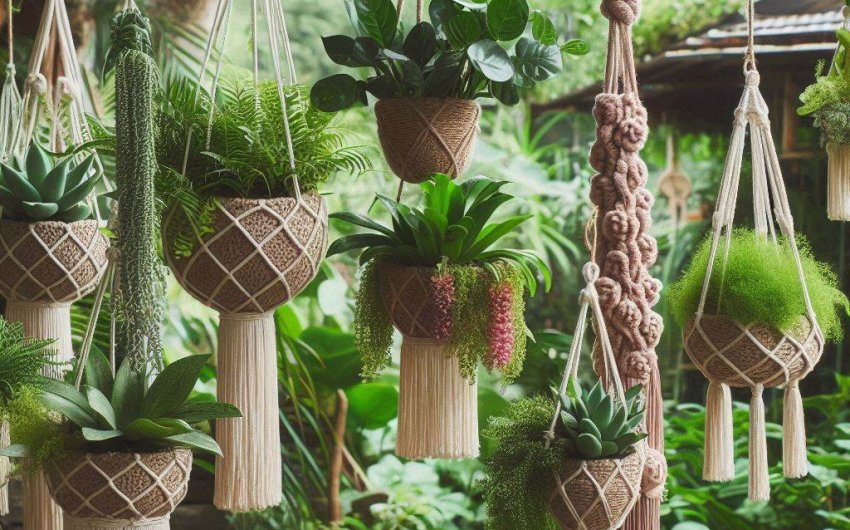
Do you love the look of plants hanging in your garden but want something a bit more unique than a plain chain? DIY macrame plant hangers are the perfect solution! Macrame is an ancient art form that uses knots to create beautiful patterns. It’s super relaxing to do, and the result is a stylish, handcrafted way to display your favorite plants. This guide will walk you through everything you need to know to make your own macrame plant hangers for your garden.
Why Macrame Plant Hangers Are Great for Your Garden
Before we dive into the "how-to," let’s talk about why macrame plant hangers are such a fantastic addition to your outdoor space.
Adds Bohemian Charm
Macrame has a very distinct, artsy, and bohemian style. It brings a relaxed, natural, and handcrafted vibe to any area. In your garden, this means adding a touch of rustic elegance or a laid-back, creative feel. They blend beautifully with greenery and natural elements, making your garden feel more inviting and stylish.
Saves Space
If you have a small garden or patio, finding room for all your plants can be a challenge. Hanging planters are a great way to use vertical space. Macrame hangers allow you to suspend plants from pergolas, eaves, tree branches, or even wall hooks, freeing up valuable ground space for other decor or pathways.
Better Air Circulation for Plants
When plants are hung, they often get better air circulation around their leaves and pots. This can be healthier for some plants, helping to prevent issues like fungal growth that can occur when plants sit directly on the ground in humid conditions.
Elevates Your Greenery
Hanging plants at different heights adds visual interest and depth to your garden. It creates a dynamic display, drawing the eye upwards and showcasing your plants in a new way. Imagine a cascade of ivy or colorful petunias flowing from a hanging macrame planter.
A Fun and Rewarding DIY Project
Making your own macrame plant hangers is incredibly satisfying. It’s a creative outlet that results in something beautiful and useful for your home or garden. Plus, once you learn the basic knots, you can customize your hangers to fit any pot size or garden aesthetic. It's a truly personalized touch.
Materials You'll Need for Your Macrame Plant Hanger
To get started on your DIY macrame plant hanger, you’ll need a few basic supplies. Most of these can be found at craft stores or easily ordered online.
Macrame Cord
The macrame cord is the most important material. It comes in different types and sizes.
- Cotton Cord: This is the most common and popular choice. It's soft, easy to work with, and gives a lovely natural look. It’s great for beginners. You can find 3mm cotton macrame cord or 4mm cotton macrame cord, which are good starting points for plant hangers.
- Jute Cord: Made from natural fibers, jute gives a more rustic, earthy feel. It can be a bit rougher on the hands but looks great in a garden setting.
- Hemp Cord: Similar to jute but often softer and stronger. It’s very durable for outdoor use.
- Synthetic Cords (e.g., Polyester): These are great for outdoor use as they are often more weather-resistant and less prone to mildew. They might not have the same soft feel as cotton but are very practical for the garden.
- Cord Thickness: For plant hangers, a cord thickness between 3mm and 6mm is usually ideal. Thicker cords create bolder knots and a sturdier hanger, while thinner cords allow for more intricate designs.
Ring or Dowel for Hanging
You’ll need something to start your hanger from.
- Wooden Ring: A wooden macrame ring is a classic choice and looks very natural. Choose one that’s sturdy enough to hold your plant.
- Metal Ring: A metal O-ring or a metal macrame hoop works well too and can add a modern touch.
- Driftwood or Branch: For a truly rustic and unique look, you can use a sturdy piece of driftwood or a clean, strong branch as your hanging point.
Scissors
Good, sharp scissors are essential for cutting your cord cleanly.
Measuring Tape or Ruler
You’ll need to measure your cord lengths accurately. A retractable measuring tape is handy.
S-Hook or Clothes Hanger
This is for holding your project while you work. You can hang your ring or dowel from an S-hook on a curtain rod, a clothes hanger, or even a door knob. This makes knotting much easier.
Optional: Beads
To add a decorative touch, you can string wooden beads for macrame onto your cords. Make sure the hole in the bead is large enough for your chosen cord thickness. Large hole wooden beads are perfect.
Essential Macrame Knots for Plant Hangers
Don't be intimidated by knots! For a basic plant hanger, you only need to learn two main knots, plus a starting knot. Once you master these, you can create many different designs.
1. Lark's Head Knot (Starting Knot)
This knot is used to attach your cords to the hanging ring or dowel.
- Fold your cord in half to find its midpoint.
- Place the folded loop over the top of your ring.
- Bring the two loose ends of the cord through the loop.
- Pull tight to secure the cord to the ring.
- Each cord attached this way creates two working strands.
2. Square Knot
The square knot is a fundamental macrame knot and is used to create strong, flat patterns. It’s made up of two half-hitches.
- You need four strands of cord to make a square knot. Think of them as strands 1, 2, 3, and 4 from left to right. Strands 2 and 3 (the middle ones) are called the "filler cords" and stay straight. Strands 1 and 4 (the outer ones) are the "working cords" and do the knotting.
- Step 1 (First Half): Take the left working cord (strand 1) and cross it over the filler cords (strands 2 & 3) and under the right working cord (strand 4), forming a "P" shape.
- Step 2 (First Half): Take the right working cord (strand 4) and bring it under the filler cords (strands 2 & 3) and up through the loop created by the left working cord (strand 1).
- Step 3 (First Half): Pull both working cords evenly to tighten the first half of the knot.
- Step 4 (Second Half): Now, take the right working cord (which is now on the left side) and cross it over the filler cords and under the left working cord (which is now on the right side), forming a "reverse P" shape.
- Step 5 (Second Half): Take the left working cord (which is now on the right side) and bring it under the filler cords and up through the loop created by the right working cord.
- Step 6 (Second Half): Pull both working cords evenly to tighten the second half of the knot. You’ve completed one full square knot!
3. Spiral Knot (Half Square Knot Chain)
The spiral knot is simply a series of consecutive first-half square knots. Instead of alternating sides as you do with a full square knot, you always start with the same side.
- Use four strands, as with the square knot.
- Continuously repeat "Step 1, 2, 3" from the square knot instructions. Always start the knot from the same side (e.g., always start with the left working cord over the filler cords).
- As you keep knotting, the cord will naturally twist, creating a beautiful spiral pattern.
Step-by-Step Guide: Basic Macrame Plant Hanger
This is a simple design that’s perfect for beginners. It will hold a medium-sized pot.
Step 1: Cut Your Cords
This is important! The length of your cords determines the length of your hanger. It's always better to cut too long than too short. You'll be folding these in half.
- For a plant hanger about 3 feet long (from ring to bottom of pot), cut 8 pieces of macrame cord, each about 10-12 feet long.
- Why so long? Knotting uses up a lot of cord, and you'll fold these in half, effectively giving you 16 working strands.
Step 2: Attach Cords to the Ring
- Take one 10-12 foot cord. Fold it in half.
- Attach it to your wooden macrame ring using a Lark's Head Knot. Pull it tight.
- Repeat this with all 8 cords. You should now have 16 strands hanging from your ring.
Step 3: Create the Top Section (Gathering Knot)
To start, you need to gather all your cords together below the ring to form a sturdy top section.
- Take a separate, shorter piece of cord (about 1-2 feet long).
- Gather all 16 hanging strands together about 1-2 inches below your ring.
- Place the short cord behind the gathered strands, with about 3-4 inches of the short cord sticking up (this will be end 'A').
- Wrap the longer end of the short cord (end 'B') tightly around all 16 gathered strands, working downwards. Make about 5-8 neat wraps.
- Once wrapped, thread end 'B' through the loop created by end 'A' at the top.
- Pull end 'A' from the top. This will pull end 'B' and the loop up underneath the wraps, securing the knot.
- Trim any excess from both ends of the short cord. This is called a gathering knot or wrap knot.
Step 4: Make the Arms of the Hanger (Square Knots or Spirals)
This is where your chosen design comes in. For a basic hanger, you’ll make four "arms" or sections.
- Divide your 16 hanging strands into 4 groups of 4 strands each.
- Option A: Square Knot Design:
- In the first group of 4, make a series of square knots. You might do 5-10 square knots, depending on how long you want this section.
- Repeat this for the other three groups, ensuring each arm has roughly the same number of knots so they are similar in length.
- Option B: Spiral Knot Design:
- In the first group of 4, make a series of spiral knots. Keep knotting until you have a nice spiral section of your desired length.
- Repeat for the other three groups.
- You want this section to be long enough to sit above your pot once it’s in the hanger. About 6-12 inches of knots is a good start.
Step 5: The "Basket" Section (First Set of Connecting Knots)
This step creates the top part of the "basket" that will hold your pot.
- Measure down about 4-6 inches from the bottom of your first set of knots (the arms you just made).
- Now, take 2 strands from one group and 2 strands from the adjacent group. These 4 strands will form a new group.
- Make a single square knot with these 4 strands.
- Repeat this process all the way around. You will end up with 4 new square knots, forming a circle. This connects the arms you just made.
Step 6: The Basket Base (Second Set of Connecting Knots)
This creates the main base of your plant hanger, forming the cradle for your pot.
- Measure down about 4-6 inches from the square knots you just made in Step 5. The distance here depends on the height of your pot. You want the bottom of the pot to sit snugly.
- Again, take 2 strands from one of the previous knot groups and 2 strands from the adjacent group.
- Make a single square knot with these 4 strands.
- Repeat this all the way around, creating another set of 4 connecting square knots.
Step 7: The Bottom Gathering Knot (Holding the Pot)
This knot forms the very bottom of the hanger, keeping the pot from falling through.
- Gather all 16 of your hanging strands together below the last set of connecting knots.
- Perform another gathering knot using a fresh, short piece of cord, similar to how you did the top gathering knot. This will secure all the cords together at the bottom.
- Trim any excess cord from the ends of the short wrapping cord.
Step 8: Finishing Touches
- Trim the excess cord from the bottom of your hanger. You can cut them all to the same length for a clean look, or cut them at different lengths for a fringed effect.
- You can also add macrame beads in between knot sections if you want to. To do this, thread beads onto pairs of cords before making your knots.
- Hang your plant hanger and place your potted plant inside! Adjust the knot spacing slightly if needed to ensure your pot sits securely.
Tips for Success with Your Macrame Plant Hangers
Making macrame is fun, but a few tips can make the process even smoother and ensure your hangers are strong and beautiful.
Practice Your Knots
Before you start on your actual hanger, grab some scrap cord and practice the square knot and spiral knot. Once you get the rhythm, it becomes much easier. Consistency in your knots makes a big difference in the final look.
Measure Twice, Cut Once
Cord length is crucial. It’s better to have too much cord than too little. You can always trim excess, but you can’t add more! A common rule of thumb is to cut your working cords 4-8 times the desired final length of your project, especially for beginners. For plant hangers, where you fold cords in half, consider the total length of the doubled strands.
Use a Clipboard or S-Hook
Working on a macrame project is much easier if it's held steady. Hang your ring or dowel from an S-hook, a clothes hanger, or even clip it to a clipboard attached to a table. This keeps your working area stable and your hands free for knotting.
Keep Tension Even
Try to maintain consistent tension as you tie your knots. If some knots are tight and others are loose, your hanger might look uneven or hang crooked. Take your time and pull each knot with similar force.
Protect Your Hands
If you're working with a rougher cord like jute or hemp, or if you're knotting for a long time, your hands might get sore. Consider wearing thin gloves or taking breaks.
Experiment with Design
Once you've made a basic hanger, don't be afraid to try different patterns!
- Alternating Square Knots: Instead of making one long section of square knots, you can make a few, then leave a gap, then make another set, to create interesting textures.
- Adding Beads: As mentioned, beads are an easy way to add pops of color or texture.
- Different Arm Lengths: You could create a more asymmetrical look by making some arms longer than others, though this is more advanced.
Consider Your Pot Size
Before you start, think about the size and weight of the pot you intend to use.
- A small macrame plant hanger will use less cord and have tighter "basket" sections.
- A large macrame plant hanger for a heavier pot will require thicker, stronger cord and potentially more knotting in the base to ensure it's secure.
- Measure the circumference and height of your pot to help determine the spacing of your connecting knots.
Outdoor Durability
If your DIY macrame plant hanger will be exposed to the elements:
- Choose the right cord: Opt for synthetic cords (like polyester) or treated natural cords for better weather resistance. Untreated cotton or jute can get moldy if constantly wet.
- Consider a drainage hole: Ensure your plant pot has good drainage, and that the macrame doesn't block it.
- Occasional cleaning: If your outdoor hanger gets dirty, you can usually gently hose it down with water and mild soap, then let it air dry completely in the sun.
Ideas for Displaying Your Macrame Plant Hangers in the Garden
Once your beautiful new plant hangers are ready, it's time to put them to good use in your garden!
From a Pergola or Arbor
This is a classic spot. Hanging multiple macrame plant hangers from a pergola or arbor creates a stunning focal point. You can vary the lengths to create a tiered effect. Use different types of plants for variety – trailing ivy, colorful annuals, or herbs.
On a Porch or Patio
Dress up your porch or patio by hanging hangers from the eaves or from sturdy hooks in the ceiling. This adds immediate charm and makes your outdoor living space feel more cozy and decorated. A grouping of 2-3 hangers at different heights can look fantastic.
From Tree Branches
If you have sturdy tree branches, they make excellent natural hanging points. Make sure the branch is strong enough to support the weight of the plant and hanger, especially after watering. Use an S-hook or a strong rope loop to hang the macrame from the branch, ensuring it doesn't damage the tree bark.
Against a Wall (with a Wall Hook)
Don't have a large overhang? You can install decorative wall hooks for plants on an outdoor wall or fence. This is a great way to create a vertical garden display, especially if you have a bare wall that needs some life.
In a Potting Shed or Greenhouse
For a rustic, functional look, hang your macrame plant hangers inside your potting shed or greenhouse. They'll add to the natural, earthy vibe and keep your plants organized.
Creating a Macrame "Curtain"
For a truly ambitious project, you could create a series of macrame plant hangers that act as a living curtain on a large wall or across an open archway. Vary the types of plants and the lengths of the hangers for a lush, organic screen.
Making your own DIY macrame plant hangers is a rewarding project that allows you to add a unique, handcrafted touch to your garden. With just a few simple knots and some cord, you can create beautiful hanging displays that elevate your greenery and bring bohemian charm to your outdoor oasis. So grab your cord, start knotting, and watch your garden transform!