
What's the difference between hot composting and cold composting?
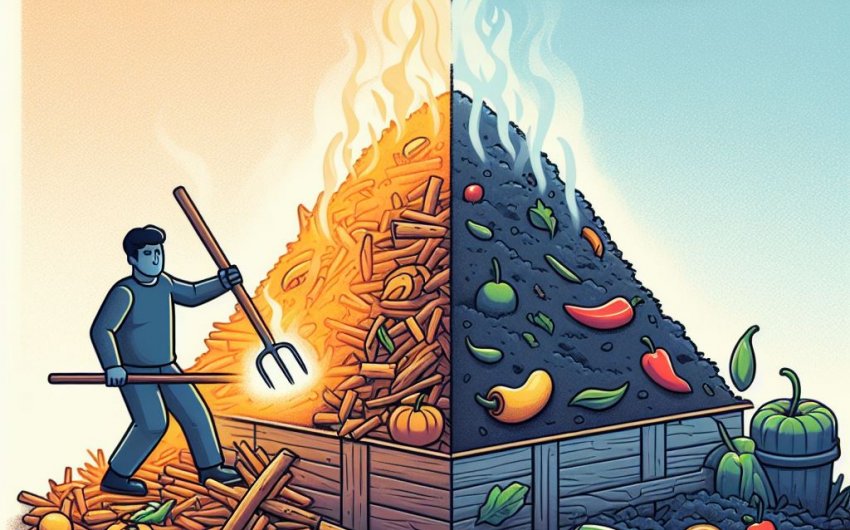
Composting is like magic for your garden. It takes kitchen scraps, leaves, and other organic bits, and turns them into a super-rich, dark, earthy material called compost that makes your plants incredibly happy. It's a fantastic way to reduce waste, improve your soil, and save money on fertilizers. But if you've ever looked into composting, you might have heard terms like "hot composting" and "cold composting" and wondered what the difference is. Are they completely different methods, or just variations of the same idea?
While both hot and cold composting achieve the same goal – breaking down organic matter into valuable compost – they go about it in very different ways, with different demands on your time and different end results in terms of speed and effectiveness. Choosing the right method depends on how much effort you want to put in, how quickly you need finished compost, and what materials you'll be using. Understanding these two main approaches will help you pick the perfect composting strategy for your garden and lifestyle. Let's dive into the specifics of each.
What is Composting, Anyway?
Before we get into hot versus cold, let's quickly recap what composting actually is. At its heart, composting is a natural process where tiny living things – like bacteria, fungi, and worms – break down organic materials into simpler, stable compounds. It's basically speeding up nature's recycling program.
The Four Key Ingredients for Composting
To make compost, you need a good balance of four things:
- Greens (Nitrogen): These are materials rich in nitrogen, which fuel the microbes and make the pile active. Examples include fresh grass clippings, kitchen scraps (fruit and vegetable peels), coffee grounds, and fresh manure.
- Browns (Carbon): These materials are rich in carbon, which provides energy for the microbes and adds bulk and structure to the pile, allowing for good airflow. Examples include dry leaves, shredded paper, cardboard, straw, and wood chips.
- Water (Moisture): Just like us, microbes need water to live and work. The compost pile should be consistently moist, like a wrung-out sponge.
- Air (Oxygen): Most beneficial composting microbes are aerobic, meaning they need oxygen to thrive. Good airflow prevents the pile from becoming smelly and slimy.
When these four ingredients are in the right balance, decomposition happens. Now, let's see how hot and cold composting handle these ingredients differently.
What is Cold Composting?
Cold composting is the simplest and most hands-off approach to composting. It's sometimes called "passive composting" or "slow composting."
The "Just Pile It Up" Method
With cold composting, you simply collect organic materials over time and pile them up. You add kitchen scraps, yard waste, and other compostable materials as they become available.
- No strict ratios: You don't need to worry much about specific "green" to "brown" ratios.
- No turning: You generally don't turn the pile regularly.
- Less maintenance: It requires minimal effort once you've started the pile.
Advantages of Cold Composting:
1. Low Effort and Maintenance
This is the biggest draw for cold composting. You don't need to spend much time or energy on it. Just add materials, and nature does the rest. It's perfect for busy gardeners or those new to composting who want to try it out without a big commitment.
2. Great for Small Quantities
If you only generate a small amount of kitchen waste or occasional yard trimmings, a cold compost pile is ideal. You can add materials gradually without needing a large, active pile.
3. Flexible with Materials
You can be less precise with your "green" and "brown" balance. While a good mix helps, a cold compost pile will still break down materials even if the ratios aren't perfect. It's more forgiving.
4. No Need for Special Equipment
You don't need a fancy compost tumbler or a multi-bin system. A simple wire bin, a Compost Bin made from Plastic, or even just a designated spot in your yard will work. A DIY pallet compost bin works perfectly for cold composting.
Disadvantages of Cold Composting:
1. Very Slow Process
This is the main drawback. Because the pile doesn't heat up, the microbes work much slower. It can take anywhere from 6 months to 2 years for materials to fully break down into usable compost. This means you'll wait a long time for your "black gold."
2. Doesn't Kill Weed Seeds or Pathogens
Since the pile doesn't reach high temperatures, weed seeds and plant disease pathogens (like fungal spores) might survive the composting process. If you add diseased plants or weeds with seeds, they could end up spreading these issues when you use the finished compost in your garden.
3. May Attract Pests
Because the decomposition is slow and the temperatures are low, food scraps in a cold compost pile are more likely to attract unwanted visitors like rodents, flies, or other scavengers. You should avoid adding meat, dairy, or oily foods to a cold compost pile for this reason.
4. Can Produce Odors
Without proper aeration and balance, a cold compost pile can sometimes become anaerobic (lacking oxygen), leading to foul, rotten smells. This is more likely if you add too many "greens" without enough "browns" or if it gets too wet.
What Can Go into a Cold Compost Pile?
- Fruit and vegetable scraps (peels, cores, etc.)
- Coffee grounds and tea bags
- Eggshells (crushed)
- Yard trimmings (leaves, small twigs, grass clippings)
- Shredded paper and cardboard
- Straw
What to Avoid in a Cold Compost Pile:
- Meat, bones, dairy products, oils, fatty foods (attract pests)
- Pet waste (can contain harmful pathogens)
- Diseased plants or weeds with seeds (won't be killed by low temperatures)
- Chemically treated materials
- Large woody branches (take too long to break down)
What is Hot Composting?
Hot composting is a more active and demanding method, but it yields finished compost much faster and with added benefits. It's often called "active composting" or "fast composting."
The Science of Heat
Hot composting works by creating ideal conditions for thermophilic (heat-loving) bacteria. When these microbes are abundant and active, they generate significant heat as they break down organic matter. A well-managed hot compost pile can reach temperatures between (120^\circ \text{F}) and (160^\circ \text{F}) ((49^\circ \text{C}) to (71^\circ \text{C})).
Advantages of Hot Composting:
1. Fast Results
This is the main reason people choose hot composting. A properly managed hot pile can produce finished compost in as little as 3 weeks to 3 months. This is incredibly fast compared to cold composting.
2. Kills Weed Seeds and Pathogens
The high temperatures generated in a hot compost pile are sufficient to kill most weed seeds, plant disease pathogens, and harmful bacteria. This means you can add weeds (even those with seeds) and diseased plant material without worrying about spreading problems when you use the compost.
3. Controls Pests and Odors
The high temperatures break down food scraps very quickly, making them less attractive to pests. Also, proper management (balanced greens/browns and regular turning) ensures good aeration, which prevents anaerobic conditions and foul odors.
4. More Thorough Decomposition
The intense microbial activity ensures a very complete and uniform breakdown of materials, resulting in a finely textured, rich compost.
Disadvantages of Hot Composting:
1. Requires More Effort and Attention
Hot composting isn't for the casual gardener. It demands more commitment.
- "Recipe" based: You need to build the pile all at once or in large batches, ensuring the correct ratio of "greens" to "browns."
- Regular turning: The pile needs to be turned frequently (every few days to a week) to reintroduce oxygen.
- Moisture monitoring: You need to regularly check and adjust the moisture level.
2. Needs Specific Ratios
To achieve those high temperatures, you need a precise carbon to nitrogen (C:N) ratio, ideally around 25-30 parts carbon to 1 part nitrogen. This often translates to roughly 2-3 parts "browns" to 1 part "greens" by volume. This means you need to collect and store materials until you have enough of both.
3. Requires a Minimum Pile Size
For a compost pile to heat up effectively, it needs to be a certain size to insulate the heat. A minimum size of about (3 \text{ feet} \times 3 \text{ feet} \times 3 \text{ feet}) ((0.9 \text{ meters} \times 0.9 \text{ meters} \times 0.9 \text{ meters})) is generally recommended. This might be too large for very small yards or if you don't generate much waste.
4. May Require Specific Tools
While not strictly necessary, tools like a compost thermometer to monitor temperature (a Compost Thermometer can be very helpful) and a robust compost fork (a Compost Fork is invaluable) make the process easier.
What Can Go into a Hot Compost Pile?
- All "green" materials: Fresh grass clippings, kitchen scraps (fruit/veg peels, coffee grounds, tea bags), fresh manure.
- All "brown" materials: Dry leaves, straw, shredded paper, cardboard (torn small), wood chips (best if small and aged).
- Even diseased plants and weeds with seeds (because the heat will kill them).
What to Avoid in a Hot Compost Pile:
- Meat, bones, dairy, oily foods: While hot temperatures can break them down, they can still attract pests and cause odors if the pile isn't consistently hot enough or if not managed properly. Best to avoid for home composters.
- Pet waste (dog, cat): While theoretical temperatures might kill pathogens, it's safer to avoid.
- Treated wood: Contains chemicals.
- Heavily processed foods: Can attract pests.
The Composting Process (Simplified for Both Types)
Regardless of whether you choose hot or cold, the basic stages of decomposition are similar.
1. Mesophilic Stage (Initial Breakdown)
When you first build a pile (or start adding to a cold pile), microbes that thrive at moderate temperatures ((50-100^\circ \text{F}) or (10-38^\circ \text{C})) begin the breakdown process. This stage is typical of cold composting throughout its entire cycle.
2. Thermophilic Stage (The Heat Wave - Hot Composting Only)
In a well-built hot compost pile, as the mesophilic microbes break down easily digestible materials, they rapidly multiply and generate heat. The temperature then rises, and thermophilic microbes take over. This is when the pile gets truly hot, effectively killing off weed seeds and pathogens. This stage can last for a few days to several weeks. Regular turning helps maintain this heat.
3. Curing/Maturing Stage (Cool Down)
After the most active decomposition, the pile starts to cool down. This is the curing or maturing phase. The remaining breakdown is handled by a new set of microbes, fungi, and larger organisms like worms. During this phase, the compost stabilizes and develops its rich, earthy smell and crumbly texture. This is when the "black gold" becomes truly ready for your garden.
How to Get Started with Hot Composting: A Quick Guide
If you're feeling ambitious and want fast results, here's a basic recipe for starting a hot compost pile:
- Collect materials: You'll need a large amount of "greens" and "browns" at the same time to build the pile all at once. Aim for roughly 2-3 parts brown to 1 part green by volume. Shred or chop larger materials into smaller pieces ((1-2) inches) to speed up breakdown.
- Choose a bin: A multi-bin system (like a 3-bin DIY pallet compost bin) or a large compost tumbler works well. You need something that can hold a (3 \text{ ft} \times 3 \text{ ft} \times 3 \text{ ft}) pile.
- Build the pile:
- Start with a base layer of coarse browns (twigs, straw) for drainage and airflow.
- Alternate layers of "greens" and "browns." Each layer can be a few inches thick.
- Moisten each layer as you build it.
- Add water: As you build, moisten the layers until the entire pile is consistently damp, like a wrung-out sponge.
- Monitor temperature: Use a compost thermometer to check the internal temperature. It should ideally reach (120-160^\circ \text{F}) ((49-71^\circ \text{C})).
- Turn the pile: Once the temperature starts to drop (usually every 2-7 days), it's time to turn the pile. Use a compost fork to mix the outer, cooler material into the center and bring the hotter material to the outside. This reintroduces oxygen and keeps the microbes working.
- Keep moist: Check moisture levels each time you turn, and add water if needed.
- Patience (for a few weeks!): After several turns and consistent high temperatures, the pile will eventually stop heating up and will look uniformly dark and crumbly. This indicates it's entering the curing phase. Let it sit for a few more weeks to mature before using.
Choosing the Right Composting Method for You
So, which method is best for your garden? It really depends on your needs and lifestyle.
Choose Cold Composting if:
- You want the easiest, most hands-off approach.
- You don't need finished compost quickly.
- You generate small amounts of organic waste gradually.
- You don't want to deal with precise ratios or frequent turning.
- You don't plan to compost meat, dairy, or diseased plants.
- You have a small garden or limited space.
Choose Hot Composting if:
- You want finished compost quickly (within months).
- You want to kill weed seeds and plant pathogens.
- You generate a large amount of organic waste all at once (e.g., after a big yard cleanup).
- You are willing to invest more time and effort into managing the pile (turning, monitoring).
- You want to reduce odors and deter pests more effectively.
- You have enough space for a larger pile.
Hybrid Approach: The Best of Both Worlds?
Many home gardeners actually use a hybrid approach that combines elements of both.
- Initial cold storage: Some people maintain a cold compost pile for daily kitchen scraps and small additions.
- Batch processing: When they have accumulated enough material (especially "greens" like fresh grass clippings or a large batch of fall leaves), they then build a smaller, dedicated hot compost pile to quickly break down a batch of material.
- Compost Tumbler: A Compost Tumbler can bridge the gap. It's easier to turn than a traditional pile, allowing for quicker breakdown, but still requires a decent volume of material to heat up effectively.
Ultimately, both hot and cold composting are valuable ways to create nutrient-rich compost for your garden. There's no single "right" way to compost, only the method that best fits your goals, your time, and the materials you have available. The most important thing is to start composting, any way you can. Your garden will thank you for it!